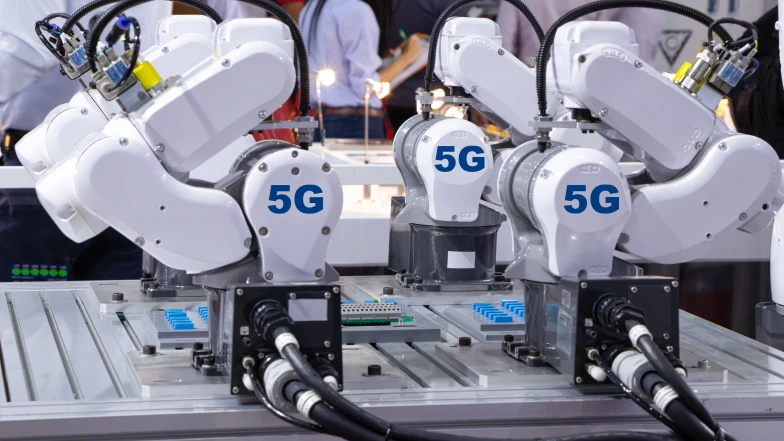
The digitisation of manufacturing processes is now driven by Industry 4.0 in which 5G will play a critical role! But how?
Well, manufacturing companies are now looking to revamp their operations. They are also willing to explore new business models to stay relevant and competitive in fast-paced markets.
However, this will need much faster collection, transfer, and analysis of huge volumes of data in factories. Here comes the role of 5G in this fast-paced manufacturing sector of India!
In this article, we will elucidate how 5G networks in India will transform the manufacturing sector.
Impact of 5G on the manufacturing sector
Faster data will help increase asset availability and reduction of production lead times. It is also critical for data-driven products. But there are limits to the volumes of data that can be analysed and processed. It is due to the weak bandwidth of existing networks and insufficient capacity that the existing Wi-Fi shop floor networks can offer. 5G is equipped with better bandwidth and can easily support huge volumes of data. Without any doubt, 5G will be a significant contributor towards boosting India's booming manufacturing sector.
Over any 4G technology and any fixed and Wi-Fi communication infrastructure, 5G networks come with loads of advantages on any given day. Compared with Wi-Fi, it works in a licensed environment that can cover a specific block of the spectrum or any specific area (like a factory). Hence, the network can be easily configured to meet a company’s specific requirements regarding coverage, capacity and business objectives.
Unlike Wi-Fi, which operates in an unlicensed environment, 5G works in a licensed environment which can be assigned to a specific block of spectrum or geographical area, such as a factory. This allows the network to be tailored to meet a company's specific needs in terms of coverage, capacity, and business goals.
Along with 5G, Wi-Fi 6 has also been developed to enhance network capacity. However, Wi-Fi 6 operates in an unlicensed environment, meaning that access does not require permission. This may lead to potential issues like interference among wireless operators.
On the other hand, 5G offers easy authentication and connection to mobile networks without needing any service selection. Mentioned below are some of the 5G advantages that will power manufacturing companies in India:
1. With 5G, industrial automation can be improved, enabling better control of robots and smart factory solutions.
2. Seamless end-to-end tracking of materials and goods becomes possible with 5G technology.
3. Immersive remote operations, such as maintenance, service, or assembly, can be performed more effectively.
4. 5G facilitates easy reconfiguration and layout changes on the shop floor.
5. Factory processes can be simulated in real-time using 5G capabilities.
6. Real-time monitoring of production, asset data, and status becomes possible.
7. Machine-to-machine communication can occur in real-time, thanks to 5G's capabilities!
8. Augmented reality applications, such as product assembly or asset maintenance, can be enhanced and optimised using 5G technology.
Wrapping up
With the Atmanirbhar Bharat Abhiyan, India’s manufacturing sector is on the rise. More and more companies are emerging with various areas of expertise in the manufacturing sector. From mobile phone manufacturing to automobiles and beyond, India is becoming a global hub of manufacturing. With the rollout of Jio True 5G in more than 400 cities across India, will definitely contribute to India’s bid to become a hub for smart manufacturing. However, all these developments are still at an early stage and it may take a few more years for manufacturing companies to utilise the full potential of 5G.
Impact of 5G on the manufacturing sector
Faster data will help increase asset availability and reduction of production lead times. It is also critical for data-driven products. But there are limits to the volumes of data that can be analysed and processed. It is due to the weak bandwidth of existing networks and insufficient capacity that the existing Wi-Fi shop floor networks can offer. 5G is equipped with better bandwidth and can easily support huge volumes of data. Without any doubt, 5G will be a significant contributor towards boosting India's booming manufacturing sector.
Over any 4G technology and any fixed and Wi-Fi communication infrastructure, 5G networks come with loads of advantages on any given day. Compared with Wi-Fi, it works in a licensed environment that can cover a specific block of the spectrum or any specific area (like a factory). Hence, the network can be easily configured to meet a company’s specific requirements regarding coverage, capacity and business objectives.
Unlike Wi-Fi, which operates in an unlicensed environment, 5G works in a licensed environment which can be assigned to a specific block of spectrum or geographical area, such as a factory. This allows the network to be tailored to meet a company's specific needs in terms of coverage, capacity, and business goals.
Along with 5G, Wi-Fi 6 has also been developed to enhance network capacity. However, Wi-Fi 6 operates in an unlicensed environment, meaning that access does not require permission. This may lead to potential issues like interference among wireless operators.
On the other hand, 5G offers easy authentication and connection to mobile networks without needing any service selection. Mentioned below are some of the 5G advantages that will power manufacturing companies in India:
1. With 5G, industrial automation can be improved, enabling better control of robots and smart factory solutions.
2. Seamless end-to-end tracking of materials and goods becomes possible with 5G technology.
3. Immersive remote operations, such as maintenance, service, or assembly, can be performed more effectively.
4. 5G facilitates easy reconfiguration and layout changes on the shop floor.
5. Factory processes can be simulated in real-time using 5G capabilities.
6. Real-time monitoring of production, asset data, and status becomes possible.
7. Machine-to-machine communication can occur in real-time, thanks to 5G's capabilities!
8. Augmented reality applications, such as product assembly or asset maintenance, can be enhanced and optimised using 5G technology.
Wrapping up
With the Atmanirbhar Bharat Abhiyan, India’s manufacturing sector is on the rise. More and more companies are emerging with various areas of expertise in the manufacturing sector. From mobile phone manufacturing to automobiles and beyond, India is becoming a global hub of manufacturing. With the rollout of Jio True 5G in more than 400 cities across India, will definitely contribute to India’s bid to become a hub for smart manufacturing. However, all these developments are still at an early stage and it may take a few more years for manufacturing companies to utilise the full potential of 5G.